
Research Award of the State of Lower Austria 2026: recognition for ECVA's TEPACE project and its team
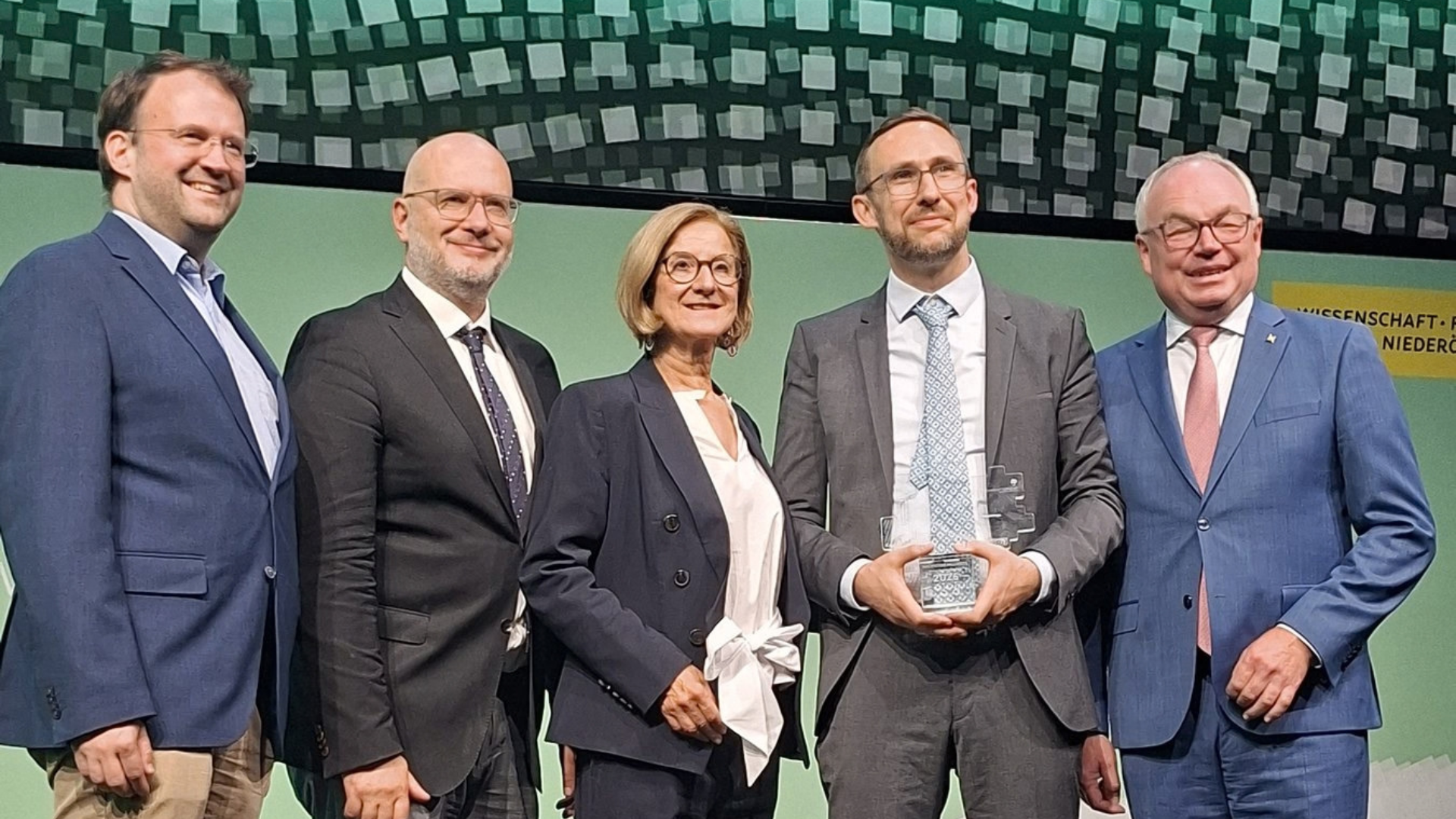
On 29 September 2026 the State of Lower Austria presented its Research Award 2026 to Roland Bernhard, co-founder and board member of the European Character and Virtue Association (ECVA). The award honours his research on character education in schools. At its core is an ECVA project: TEPACE – Teachers’ and Parents’ Perspectives on Character Education in Europe – in which more than 40 researchers from twelve countries work together.
The recognition therefore belongs to a whole team. This report describes the award and the study, and names all 47 members of the consortium.
The award
The State of Lower Austria has presented its science awards (Wissenschaftspreise) since 1964. The state government confers them on the recommendation of an expert jury, which in 2026 consisted of seven researchers from universities and research institutes. The awards honour work that makes a substantial contribution to science in Lower Austria.
Roland Bernhard is Professor of School Development, Leadership and Leadership Culture at KPH Vienna/Lower Austria (University of Teacher Education of Christian Churches) and Treasurer of ECVA. He received the Research Award 2026 (in German: Anerkennungspreis der Wissenschaftspreise des Landes Niederösterreich) for a collection of research and practice-oriented work from the Austrian Character Initiative, which he founded in 2022. TEPACE is its scientific core.
Governor Johanna Mikl-Leitner and Deputy Governor Stephan Pernkopf presented the awards at the Haus der Digitalisierung in Tulln. For the ceremony the State produced a one-minute film about the work, in German with English subtitles. It includes a video call with the international TEPACE team.
TEPACE: an ECVA project from the start
TEPACE began with a finding from England. In 2022 Tom Harrison and colleagues at the Jubilee Centre for Character and Virtues surveyed parents and teachers across England. Both groups rated good character as more important than academic attainment, and each underestimated how much the other valued it.
Was this an English peculiarity, or something European? In 2023 Roland Bernhard, Eva Müllauer and Evelyn Kropfreiter at KPH Vienna/Lower Austria, with Tiarnach McDermott at the University of Oxford, translated and adapted the English instruments and repeated the study in Austria. The Austrian data confirmed the pattern. Evelyn Kropfreiter completed her doctorate within this study.
The step to a European project was taken at an ECVA conference. When the Austrian team presented its first results in Madrid in June 2023, colleagues from several countries asked whether they could run the same study at home. Within months a consortium had formed: national teams that share one instrument, one conceptual framework and one purpose.
Roland Bernhard leads the project. Martin Brestovanský, Verónica Fernández-Espinosa and Tom Harrison form the leadership team with him; all four are members of the ECVA board. Tiarnach McDermott is responsible for the quantitative analysis. Each national team runs its own fieldwork, translation and ethics clearance. The consortium decides the common core of the instrument and the pooled analyses together, in regular video meetings and at the annual ECVA conferences.
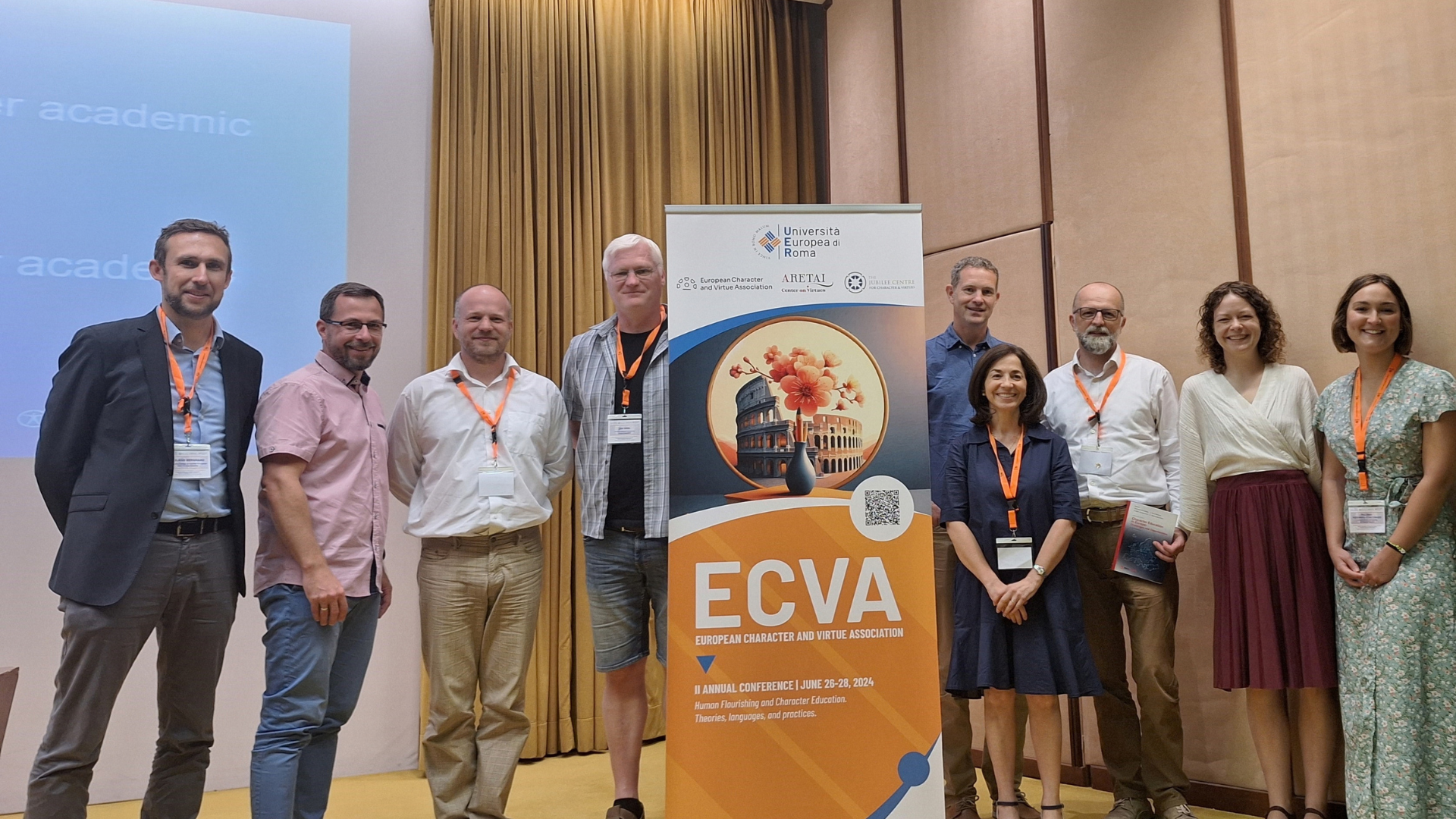
Those conferences mark the project’s path: the international TEPACE symposium in Rome in 2024, with 23 contributors from eight countries; the seven-country comparison in Vienna in 2025; and the main results in Trnava in June 2026, presented to around 100 researchers.
What the study shows
The first comparative analysis covers 10,909 respondents: 8,155 parents and 2,754 teachers from Austria, the Czech Republic, England, Germany, Latvia, Poland, Slovakia and Spain. To the consortium’s knowledge it is the largest comparative dataset of its kind currently available for continental Europe. Four findings stand out.
- A near-universal mandate. 93.3% of parents and 93.7% of teachers agree or strongly agree that character education in schools is very important (six countries).
- A perception gap. Teachers think that 54.5% of parents put attainment above character; in fact 9.2% do. Parents make the same mistake about teachers: 37.7% presumed, 5.9% actual (seven countries).
- No trade-off. 91.1% of teachers and 87.1% of parents expect a greater focus on character education to improve pupils’ academic attainment.
- Confident, but not everywhere. 79.3% of teachers feel confident delivering character education (six countries). Nearly a fifth of the variance lies between countries.
Parents and teachers also largely agree on the virtues that matter most. Parents put confidence first (64.4%), followed by good judgement (56.8%) and honesty (46.1%). Teachers lead with honesty (50.2%), civility (47.8%) and good judgement (46.2%). Asked what matters most when choosing a school, 82.6% of parents named the quality of teaching and 66.3% the values the school stands for; examination results followed far behind at 13.9%.
The consortium is careful about what the data can say. TEPACE is a federation of national studies that share a common core. The samples are not representative, and pooled figures are reported only for items that were administered identically.
The people behind TEPACE
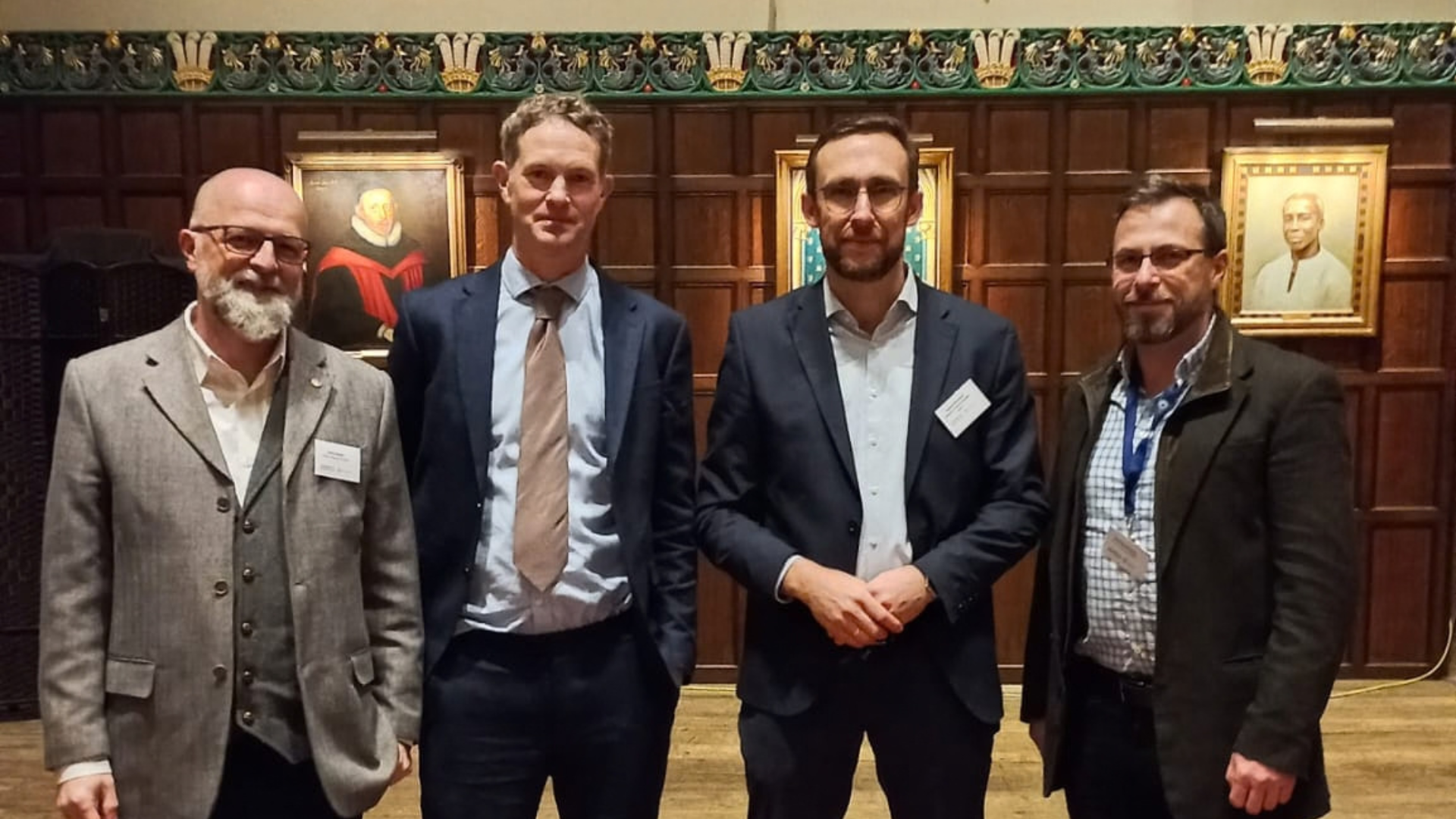
Forty-seven researchers in twelve countries carry the project, and the recognition for TEPACE is theirs too.
The project is led by Roland Bernhard (KPH Vienna/Lower Austria) together with Martin Brestovanský (Trnava University), Verónica Fernández-Espinosa (Universidad Francisco de Vitoria, Madrid) and Tom Harrison (Jubilee Centre for Character and Virtues, University of Birmingham). Tiarnach McDermott (PhD, University of Oxford) is the project’s quantitative expert.
Country | Researchers and institutions | Status |
|---|---|---|
Austria | KPH Vienna/Lower Austria: Roland Bernhard (project lead), Evelyn Kropfreiter, Eva Müllauer, Julia Lechner | In the first comparative report |
Czech Republic | Jan Hábl (University of Hradec Králové); Alžběta Vaňková, Ivo Jirásek and Barbora Bačíková (Palacký University Olomouc) | In the first comparative report |
England | Jubilee Centre for Character and Virtues, University of Birmingham: Tom Harrison | In the first comparative report |
Germany | Paris Lodron University of Salzburg, whose team conducted the German survey: Ines Weber, Sarah Natalie Krejza (project assistant) | In the first comparative report |
Latvia | University of Latvia, Riga: Manuel Joaquín Fernández González, Irina Maslo, Tamāra Pīgozne, Svetlana Surikova | In the first comparative report |
Poland | University of Gdańsk: Paweł Sikora, Natasza Szutta, Artur Szutta, Jagoda Mielczarek | In the first comparative report |
Slovakia | Trnava University: Martin Brestovanský, Andrej Rajský, Marek Wiesenganger, Romana Martincová, Lucia Kočišová, Veronika Javorková, Anna Sádovská | In the first comparative report |
Spain | Verónica Fernández-Espinosa and Marta Velázquez Gil (Universidad Francisco de Vitoria, Madrid); Paloma Redondo-Corcobado (Universidad Internacional de La Rioja) | In the first comparative report |
Croatia | Anita Calvert (University of Kent Academies Trust · Philosopher’s Mind); Ivan Koprek, Ante Belić, Dan Đaković, Marija Džinić, Marijana Kolednjak and Mikolaj Martinjak (University of Zagreb) | Collecting data since 2024 |
Hungary | University of Sopron: Beatrix Faragó | Collecting data |
Iceland | Ingimar Ólafsson Waage (Iceland University of the Arts, Reykjavík); Sigríður Ingadóttir, Íris Hrönn Kristinsdóttir, Garðar Árnason and Gunnar Gíslason (University of Akureyri) | Collecting data |
Italy | Maria Silvia Vaccarezza (Università degli Studi di Genova); Claudia Navarini (Università Europea di Roma); Michel Croce (Aretai – Center on Virtues); Martina Piantoni | Collecting data |
Eight national teams contributed data to the first comparative report. Three more are collecting data, and a fourth team is being set up.
The national teams also publish their own country studies. So far these have appeared or are in press for Austria, the Czech Republic, Latvia, Poland, Slovakia and Spain. Twelve publications have come out of the project to date, and six more are submitted or in preparation.
From evidence to policy and practice
The findings are already being used.
- Austria. The results were presented to the Education Directorate of Lower Austria, among others to around 100 school quality managers and 160 school leaders. They contributed to a major step: character education and leadership is the annual theme for all schools in Lower Austria in the school year 2026/27.
- Slovakia. The Slovak team used its national findings to support the implementation of character-education standards through Slovakia’s new national curriculum.
- Spain. In November 2025 the Spanish team presented the findings to policymakers of the Community of Madrid with a dedicated dossier.
- Europe. In June 2026 the Trnava Declaration on Character Education was launched at the ECVA conference. It calls on European institutions, education authorities, schools and universities to recognise character education as a fundamental dimension of excellent education.
ECVA’s conferences have given the project a public stage. At the conference in Vienna in 2025, with 130 participants from 23 countries, the President of the European Parliament, Roberta Metsola, addressed the participants in a personal video message. In Trnava in 2026 a policy panel with representatives of the Slovak Ministry of Education, the Global Character Alliance and ECVA discussed what the results mean for policy.
The project’s final report sums it up: “Europe, on the evidence of the TEPACE data, already seems to have the social consensus it needs to move this agenda forward. What it needs now is the individual, institutional and political will to act on it.”
An award for the whole team, and what comes next
After the ceremony Roland Bernhard said: “This award does not belong to one person. It belongs to a team of more than 40 researchers from twelve countries, to my colleagues at KPH Vienna/Lower Austria, to the Education Directorate of Lower Austria — and to the many school leaders and teachers who help children, day after day, to become honest, courageous, grateful and strong.”
In its brochure on the 2026 awards, the State of Lower Austria asked him about ECVA and the value of networks in research. His answer: “Over the past 15 years, starting from Oxford, Birmingham and Harvard, a lively international movement of researchers has formed who work on character education and character-based leadership at the highest academic level and with strong influence on policy and practice. I am proud to be part of this positive movement and, with ECVA, to make a contribution for Europe.”
The work continues. Croatia, Iceland and Italy are collecting data, and a Hungarian team is being set up. The comparative article on the first eight countries is under review. The consortium is preparing a second phase: a longitudinal follow-up in a subset of TEPACE schools, a comparative analysis of the qualitative material that several teams collected, and an openly published, revised version of the instrument.
Research teams that would like to join are welcome to contact the project lead. The next ECVA conference takes place in Stockholm from 30 June to 2 July 2027.
Further information
- TEPACE on the ECVA website
- The TEPACE project page: design, findings, consortium and publications
- The award: the evening in Tulln, photos and media coverage
- Short film of the State of Lower Austria (one minute, German with English subtitles)
- Press release of the State of Lower Austria, 30 September 2026 (in German)
- Brochure of the State of Lower Austria on the 2026 awards (PDF, in German)
- ECVA Conference 2027 in Stockholm