
TEPACE: Teachers’ and Parents’ Perspectives on Character Education in Europe
What do the adults closest to children — their parents and their teachers — actually think about the moral formation of young people in school? TEPACE asked them — 10,909 of them, in eight European countries so far. The answer is clearer than most policy debates assume: the two groups want the same thing, and each believes the other does not.
Countries in the consortium — eight in the pooled analysis, four more in preparation or fieldwork
Respondents: 8,155 parents and 2,754 teachers
Researchers from universities and research centres in twelve countries
Publications so far, six more submitted or in preparation
A finding from England that would not let us go
In 2022, Tom Harrison and colleagues at the Jubilee Centre for Character and Virtues in Birmingham published a survey of parents and teachers across England. Two things stood out. When asked directly, both groups rated the development of good character as more important than academic attainment. And each group systematically underestimated how much the other valued character. Much of the hesitation around character in schools, it seemed, rested on a misperception rather than on any real disagreement about what schools are for.
Was that an English peculiarity, shaped by an unusually accountability-driven school culture — or something European? In 2023, Roland Bernhard, Eva Müllauer and Evelyn Kropfreiter at KPH Vienna/Lower Austria, with Tiarnach McDermott at the University of Oxford, translated and adapted the English instruments and repeated the study in Austria. The Austrian data confirmed the English pattern. Evelyn Kropfreiter completed her doctorate within this study; its results appeared in the Journal of Moral Education and the Journal of Character Education.
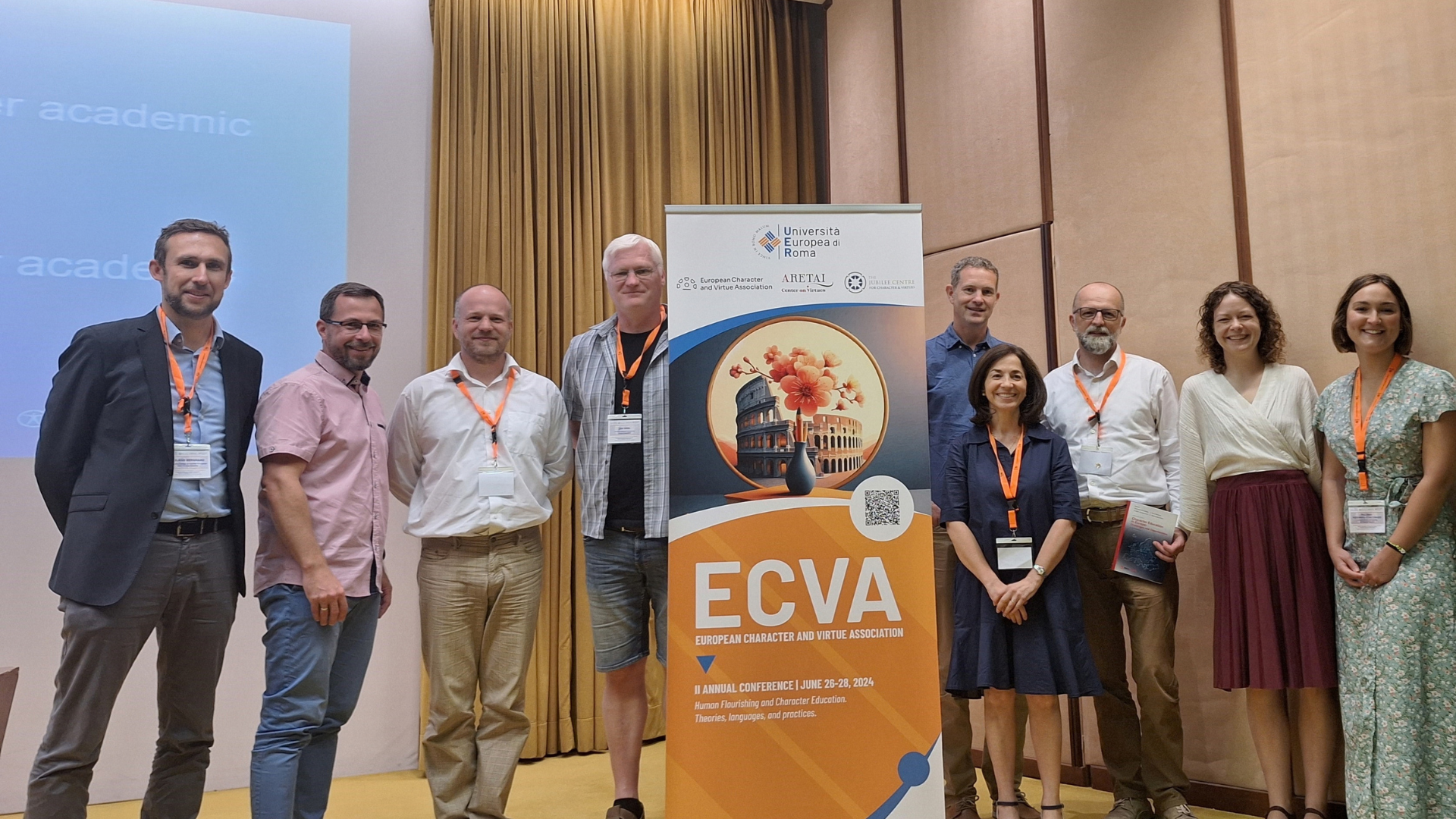
When the Austrian team presented its first results at the ECVA Conference in Madrid in June 2023, colleagues from several countries asked whether they could run the same study at home. Within months the replication had become a consortium — a loose federation of national teams sharing one instrument, one conceptual framework and one purpose. Roland Bernhard leads it; Martin Brestovanský, Verónica Fernández-Espinosa and Tom Harrison form the leadership team, all board members of the European Character and Virtue Association.
Evelyn Kropfreiter presenting the Austrian TEPACE study at Oriel College, Oxford, January 2023
Evelyn Kropfreiter presenting the Austrian study at the Jubilee Centre’s annual conference, Oriel College, Oxford, January 2023 — the point from which TEPACE grew.
Four findings from 10,909 parents and teachers
The pooled analysis covers Austria, the Czech Republic, England, Germany, Latvia, Poland, Slovakia and Spain. To our knowledge it is the largest comparative dataset of its kind currently available for continental Europe.
A near-universal mandate
93.3% of parents and 93.7% of teachers agree or strongly agree that character education in schools is very important (six countries).
The perception gap
Teachers think 54.5% of parents put attainment above character. In reality, only 9.2% do — a six-fold overestimate. Parents make the same mistake about teachers (seven countries).
No trade-off
91.1% of teachers and 87.1% of parents expect a greater focus on character education to improve pupils’ academic attainment. Hardly anyone expects harm.
Confident — but not everywhere
79.3% of teachers feel confident delivering character education (six countries). Nearly a fifth of the variance lies between countries: where teachers work matters.
A network that grew out of conversations, not a call for proposals
The consortium brings together 47 researchers in twelve countries. Each national team runs its own fieldwork, translation and ethics; the consortium decides the common core of the instrument and the pooled analyses together, in regular video meetings and at the annual ECVA conferences. Eight countries contributed data to the first comparative report; three more are collecting data and a fourth team is being set up.
Austria
- Roland Bernhard
- Evelyn Kropfreiter
- Eva Müllauer
- Julia Lechner
Croatia
- Anita Calvert
- Ivan Koprek
- Ante Belić
- Dan Đaković
- Marija Džinić
- Marijana Kolednjak
- Mikolaj Martinjak
Czech Republic
- Jan Hábl
- Alžběta Vaňková
- Ivo Jirásek
- Barbora Bačíková
England
- Tom Harrison
Germany
- Ines Weber
- Sarah Natalie Krejza
Hungary
- Beatrix Faragó
Iceland
- Ingimar Ólafsson Waage
- Sigríður Ingadóttir
Latvia
- Manuel Joaquín Fernández González
- Irina Maslo
- Tamāra Pīgozne
- Svetlana Surikova
Poland
- Paweł Sikora
- Natasza Szutta
- Artur Szutta
- Jagoda Mielczarek
Slovakia
- Martin Brestovanský
- Andrej Rajský
- Marek Wiesenganger
- Romana Martincová
- Lucia Kočišová
- Veronika Javorková
- Anna Sádovská
Spain
- Verónica Fernández-Espinosa
- Marta Velázquez Gil
- Paloma Redondo-Corcobado
From a replication to a European evidence base
The English study
Tom Harrison and colleagues at the Jubilee Centre survey parents and teachers across England and describe the ascription–actuality gap for the first time.
Replication in Austria
The Austrian team adapts the instruments and surveys teachers and parents. First results are presented at Oriel College, Oxford (January) and at the ECVA Conference in Madrid (June) — where the consortium is born.
Fieldwork across Europe · symposium in Rome
National teams translate and run the survey. At the ECVA Conference in Rome, Roland Bernhard organises the international TEPACE symposium with Verónica Fernández-Espinosa and Tom Harrison — 23 contributors from eight countries.
First comparative results in Oxford
The consortium presents preliminary comparative findings at the Jubilee Centre’s annual conference, Oriel College, Oxford.
Seven-country comparison in Vienna
At the ECVA Conference in Vienna — organised by Roland Bernhard, 130 participants from 23 countries — the team presents perceived priorities in character and attainment across seven countries.
Publications and policy
Country studies appear in Slovakia, Spain, the Czech Republic, Latvia and Austria. The Spanish team presents the results to policymakers in Madrid. Lower Austria makes character education and leadership the annual theme for all its schools in 2026/27.
Keynote in Zagreb
“A mandate for character education”: Roland Bernhard, Martin Brestovanský, Verónica Fernández-Espinosa and Tom Harrison present the evidence on shared priorities at the international symposium Character Matters, University of Zagreb.
Main results, policy panel and the Trnava Declaration
At the ECVA Conference in Trnava — “Bridging the Knowledge–Action Gap in Character Development” — the main results are presented to around 100 researchers. A policy panel with representatives of the Slovak Ministry of Education, a former minister, the Global Character Alliance and ECVA discusses the implications, and the Trnava Declaration on Character Education is launched.
Final report and the next wave
The final report of the first wave is completed. The concluding comparative article has been submitted to an international peer-reviewed journal and is under review. Croatia, Iceland and Italy continue collecting data and a Hungarian team is being set up; the consortium is preparing a longitudinal and qualitative second phase.
Research Award of the State of Lower Austria
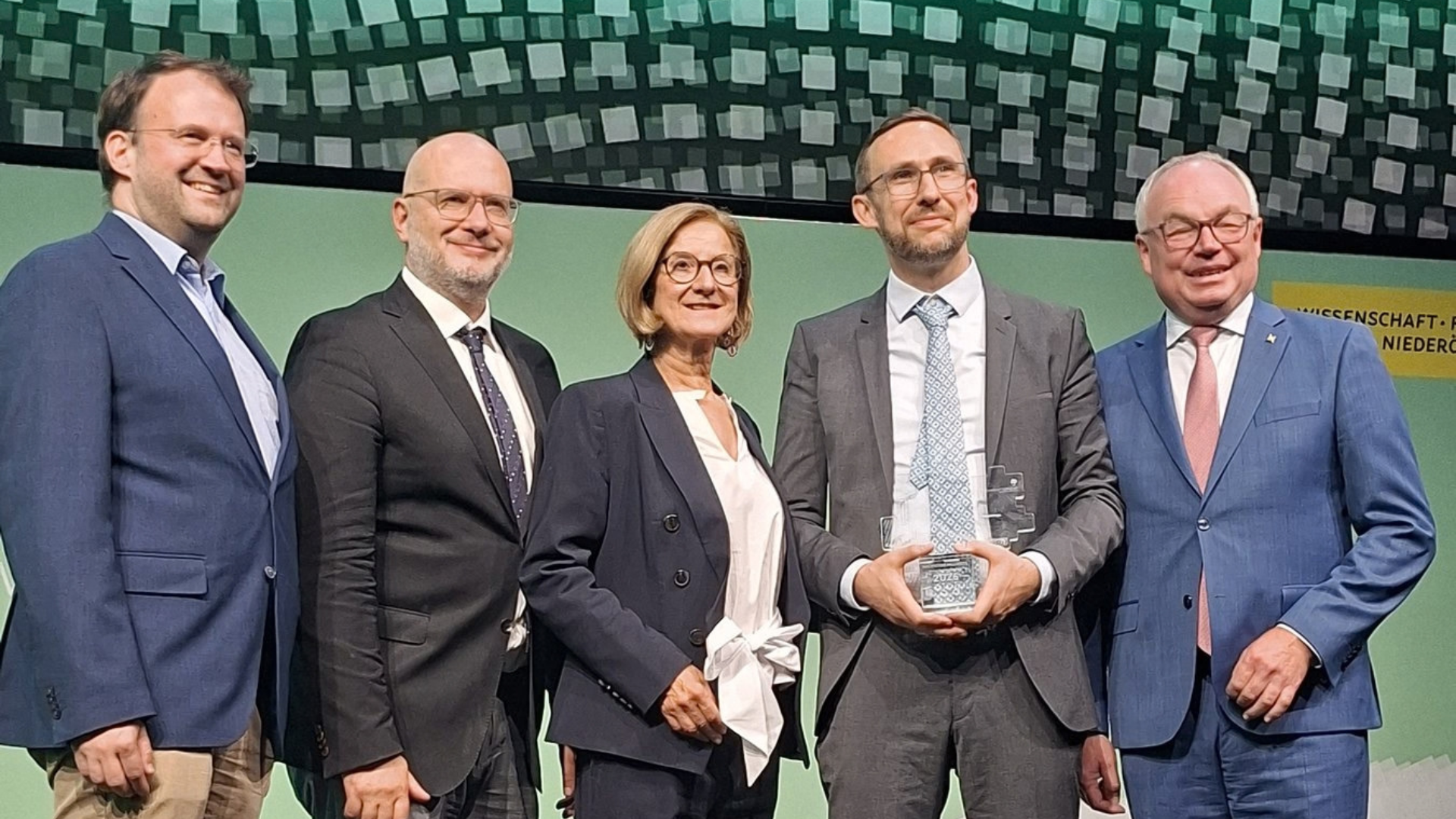
The State of Lower Austria honours Roland Bernhard with its Research Award 2026 for the research on character education submitted with TEPACE at its core — conferred by the state government on the recommendation of an expert advisory board. More →
Where the findings have already changed something
Austria
A whole region takes up the theme
Presented to the Education Directorate of Lower Austria — among others to around 100 school quality managers and 160 school leaders — the TEPACE findings contributed to a major implementation step: character education and leadership became the annual theme for all schools in Lower Austria in the school year 2026/27. Roland Bernhard wrote the accompanying workbooks for school leaders. Workbook and tools →
Slovakia
Character standards in the national curriculum
The Slovak team used the national TEPACE findings to support the implementation of character-education standards in school practice through Slovakia’s new national curriculum, and presented the project at a conference of the National Institute for Education and Youth.
Spain · Europe
Madrid, and a declaration for Europe
In November 2025 the Spanish team presented the findings to policymakers of the Community of Madrid with a dedicated dossier. In June 2026 the Trnava Declaration on Character Education, launched at the ECVA conference, called on European institutions, education authorities, schools and universities to recognise character education as a fundamental dimension of excellent education.
“Europe, on the evidence of the TEPACE data, already seems to have the social consensus it needs to move this agenda forward. What it needs now is the individual, institutional and political will to act on it”. TEPACE Final Report, 2026
Twelve published, six on the way
National teams publish their own country studies; the comparative results are written up by the whole consortium. Published, accepted and in-press outputs to date:
Comparative
Character education in schools: A European comparative study of teachers’ and parents’ attitudes in response to global challenges – preliminary results
Brestovanský, Bernhard, Fernández-Espinosa, Harrison, McDermott, Kropfreiter, Rajský, Wiesenganger, Javorková, Bačíková, Hábl, Pīgozne, Surikova, Fernández González, Sikora & Szutta · 13th Annual Conference of the Jubilee Centre for Character and Virtues, Oriel College, Oxford, 9–11 January 2025.
Full text →Comparative article on the main results of the first wave
Submitted to an international peer-reviewed journal; details withheld during anonymous peer review.
Austria
Austrian secondary school teachers’ views on character education: Quantitative insights from a mixed-methods study
Kropfreiter, Bernhard & McDermott · Journal of Moral Education, 55(2), 213–233.
Full text →Austrian secondary school teachers’ views on character education: Initial qualitative insights from a mixed methods study
Kropfreiter & Bernhard · Journal of Character Education, 20(1), 1–18.
Challenges and opportunities for character education in Austria
Bernhard · in: Fernández, Harrison, Kristjánsson & Bernhard (eds.), Character Education in Europe: Challenges and Opportunities, McGraw Hill.
Full text →Werteorientierte Persönlichkeitsbildung: Einblicke in die Ergebnisse einer Mixed Methods Studie
Kropfreiter & Bernhard · R&E-SOURCE. Open Online Journal for Research and Education, 12(3), 535–548, open access.
Full text →Werteorientierte Persönlichkeitsbildung in der Schule: Charakterstärken als Schlüssel für gelingende Bildung im 21. Jahrhundert
Kropfreiter & Bernhard · in: Bernhard & Hanyka (eds.), Psychosoziale Gesundheit, Charakterstärken und Lebenskompetenzen, SchulVerwaltung aktuell Österreich, 13(6), 177–178.
Country studies
Differences between teachers’ and parents’ perspectives on character education in schools in the Community of Madrid
Fernández-Espinosa, Redondo-Corcobado & Velázquez Gil · British Journal of Educational Studies, 74(4), 557–583.
Perspectives and attitudes of teachers on character education in schools in the Community of Madrid
Fernández-Espinosa, Redondo-Corcobado & Velázquez Gil · Cogent Social Sciences, 11(1), Article 2556219.
Teachers’ and parents’ perspectives on character education in Latvia: A comparative study
Surikova & Pīgozne · Acta Paedagogica Vilnensia, 56, 62–79.
Full text →Výchova charakteru v školách z pohľadu rodičov a učiteľov na Slovensku
Brestovanský · Dialogues in Education, 1(2), 1–20 · Character education in schools from the perspective of parents and teachers in Slovakia.
Výchova charakteru v evropských školách: Srovnávací studie postojů učitelů a rodičů
Hábl & Hábl · Pedagogika, 75(1), 71–78 · Character education in European schools: a comparative study of teachers’ and parents’ attitudes.
Full text →Teachers’ and parents’ perspectives on character education in Poland
Sikora, Szutta, Szutta & Mielczarek · Paedagogia Christiana.
Further country studies are in preparation or under review at international peer-reviewed journals.
One instrument, twelve school systems — and an honest note on comparability
TEPACE is a comparative survey study. Two questionnaires — one for teachers, one for parents — combine Likert-scale items with forced-choice ranking tasks and were developed iteratively by the consortium in dialogue with the Jubilee Centre’s instruments, with attention to translation equivalence across languages. Conceptually, the study draws on the neo-Aristotelian framework of the Jubilee Centre for Character and Virtues, which distinguishes moral, intellectual, civic and performance virtues.
Teachers were recruited through school networks, teacher associations and school leaders; parents typically through schools that distributed an invitation on the team’s behalf. Participation was voluntary and anonymous, and each team obtained the ethical clearances of its own institution and complied with the GDPR. Pooled analyses use multilevel models that account for the clustering of respondents in countries.
What the data can and cannot say. TEPACE is not a centrally commissioned survey with a uniform protocol and matched quotas. It is a federation of national studies that share a common core but differ in fieldwork timing, sampling frame, response rate and the range of optional items. The samples are not representative, and generalisation is limited accordingly. Pooled figures are reported only for items administered identically, and the report states which countries contributed to each figure. We would rather say this plainly than let the size of the dataset suggest a precision it does not have.
- Design: Cross-sectional comparative survey; teacher and parent questionnaires
- Sample: 10,909 respondents in eight countries; 78 % of responding parents and 77 % of teachers are women
- Framework: Jubilee Centre Framework for Character Education in Schools
- Analysis: Descriptive comparison; logistic and cumulative link mixed models with respondents nested in countries
- Funding: Foundation funding; the national teams contribute their own resources
- Coordination: European Character and Virtue Association
A second wave, and the step from beliefs to practice
The first wave answered descriptive questions in substantial detail. It cannot yet show how beliefs change over time or respond to specific practices. The consortium is therefore preparing a longitudinal follow-up in a subset of TEPACE schools, a comparative analysis of the qualitative material several teams collected alongside the surveys, and an openly published, revised version of the instrument.
The larger task is practical. Research reports do not reform schools; practitioners do. Through the annual ECVA conferences, teacher education and the Austrian Character Initiative, the findings are being turned into training, materials and school development — including the workbooks written for the annual theme in Lower Austria.